AOD Peptide (AOD-9604): Preclinical Research & Molecular Overview
All content on this page relates to preclinical laboratory research only. AOD-9604 is not approved for human medical use. No medical or purchasing advice is provided.
Research Scope Disclaimer
All content on this page relates to preclinical laboratory research only. AOD-9604 is not approved for human medical use. No medical or purchasing advice is provided.
What Is AOD Peptide (AOD-9604)?
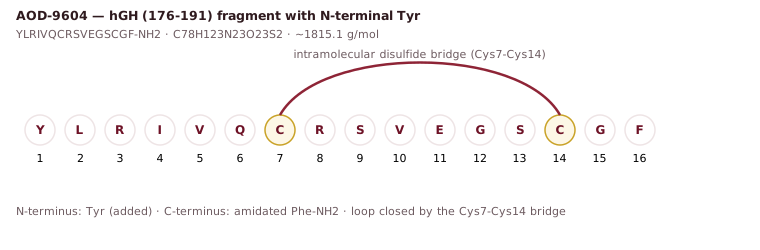
AOD-9604 is a synthetic peptide of sixteen amino acid residues. Its sequence, written in full, is Tyr-Leu-Arg-Ile-Val-Gln-Cys-Arg-Ser-Val-Glu-Gly-Ser-Cys-Gly-Phe-NH2, or YLRIVQCRSVEGSCGF in one-letter code. The C-terminus is amidated, and the two cysteine residues at positions 7 and 14 form an intramolecular disulfide bridge that holds the chain in a loop. The reported molecular formula is C78H123N23O23S2 and the reported molecular weight is approximately 1815.1 g/mol. Those figures are the ones used across this site. Values that the shared fact block does not list are not stated as numbers anywhere on these pages, and where a figure is uncertain it is written as attributed reporting instead.
The fragment was identified at Monash University in Melbourne, Australia, during the 1990s, in the course of mapping which domain of human growth hormone carries the lipid-metabolising activity. Metabolic Pharmaceuticals Ltd subsequently developed the programme. The abbreviation AOD refers to that programme and carries no regulatory meaning. Because the fragment is derived from a hormone, it is worth stating what it is not: it is not the parent hormone, it is not a growth factor preparation, and in the models used its reported activity was independent of the classical hGH receptor and was not accompanied by raised IGF-1. That last point is the one most often lost when the fragment is summarised elsewhere, and it is the reason the preclinical literature treats it as a separate object of study rather than as a short form of the hormone.
What AOD peptide research covers and does not cover
AOD peptide research, as the term is used here, means published in vitro and animal work on the fragment itself: receptor-level observations, enzyme activity measurements, gene expression data, and the formulation and analytical chemistry that supports them. It also covers the reporting of human trials, but only to the extent of noting that such trials were conducted.
What it does not cover is outcome claims. The word benefits appears on this page only inside the phrase benefits research, meaning the endpoints that published studies actually measured, such as lipolysis rate or receptor expression. No statement here promises an outcome in any organism, and no figure on the site describes what a person should expect.
AOD peptide preclinical study designs reported to date
AOD peptide preclinical study reporting in the public literature clusters into a few recurring designs. The most frequently cited work used obese mouse models, including beta3-AR knock-out mice, to test whether the fragment retains activity when that receptor is absent. Other studies examined adipocyte preparations in vitro and measured lipolysis and lipogenesis markers directly.
A second group examined mesenchymal stem cells, chondrocytes and myoblasts, and looked at articular cartilage in rabbit and rodent models. A third group addressed analytical chemistry and stability. Reviews of the fragment generally note that the number of independent replications is small, which matters when weighing any single finding from any one laboratory.
Molecular Structure & Research Background
The disulfide bridge is the structural feature that most shapes how the molecule behaves in solution. By linking Cys7 to Cys14 it constrains the sixteen residues into a loop, and the authors of the structural work reported that this rigidity slows enzymatic degradation relative to a linear chain of the same length. A plasma half-life of roughly 4 minutes was reported for murine plasma under the conditions used in that work. Half-life figures are strongly model-dependent, so the number should be read as one measurement in one system rather than as a fixed property of the compound.
Solubility follows from the sequence. The fragment carries several polar and charged side chains and is reported to be soluble in water and in aqueous buffers, which is why most published work handles it as an aqueous solution rather than in organic solvent. Research material is supplied as a lyophilised solid, white to off-white, shipped frozen and protected from light. Purity is assessed by HPLC and identity by mass spectrometry, and those two methods appear in nearly every analytical description of the fragment.
| Property | Value as reported | Note |
|---|---|---|
| Sequence, three-letter code | Tyr-Leu-Arg-Ile-Val-Gln-Cys-Arg-Ser-Val-Glu-Gly-Ser-Cys-Gly-Phe-NH2 | Amidated C-terminus |
| Sequence, one-letter code | YLRIVQCRSVEGSCGF | Sixteen residues |
| Parent region | hGH residues 176-191 | Additional N-terminal tyrosine |
| Disulfide bridge | Cys7-Cys14 | Intramolecular, constrains the chain |
| Molecular formula | C78H123N23O23S2 | As published |
| Molecular weight | Approximately 1815.1 g/mol | Value used site-wide |
| Reported plasma half-life | Roughly 4 minutes | Murine plasma, conditions as reported |
| Physical form | Lyophilised solid, white to off-white | Soluble in water and aqueous buffers |
| Analysis | HPLC for purity, mass spectrometry for identity | Standard practice in the reporting |
AOD-9604 molecular structure and its research background
AOD-9604 molecular structure work began from a question about the parent hormone: which part of human growth hormone accounts for the lipid-metabolising activity seen in early experiments. Investigators at Monash University synthesised overlapping fragments and tested them, and the C-terminal region, residues 176-191, drew attention. The fragment examined here carries an additional tyrosine at the N-terminus relative to that region.
That extra residue is a practical detail for anyone reading older papers, because the fragment and the native 176-191 sequence are not identical and are sometimes discussed together. The one-letter code YLRIVQCRSVEGSCGF and the amidated C-terminus are the most reliable way to confirm which molecule a given paper studied, since naming across the literature is inconsistent.
AOD peptide benefits research: what the studies measured
AOD peptide benefits research is a phrase that needs a narrow definition on this site. It refers to the endpoints that published studies measured and reported, not to an outcome anyone should expect. Reported measurements include lipolysis rate in adipocyte preparations, lipogenesis markers, beta3-AR expression in adipose tissue, fat oxidation in whole-animal models, and IGF-1 levels checked to test receptor independence.
Mesenchymal stem cell, chondrocyte and myoblast differentiation pathways have been measured in vitro, and cartilage parameters have been measured in rabbit and rodent models. Randomised, double-blind, placebo-controlled trials in people have been conducted and are noted here only as a matter of history. This site does not report their outcomes, does not compare their arms and does not describe the compound as active in people.
Mechanism of Action in Preclinical Research
The mechanism proposed for AOD-9604 in preclinical work has two halves. The first is a shift in adipocyte lipid handling: stimulation of lipolysis and suppression of lipogenesis were reported in adipose tissue. The second is a receptor-level proposal, namely up-regulation of the beta3 adrenergic receptor in adipocytes, which would connect the fragment to the cAMP cascade, to hormone sensitive lipase and to acetyl-CoA carboxylase.
Both halves are reported as observations in specific models, and the second is contested. Studies in beta3-AR knock-out mice indicated that receptor up-regulation is probably not the sole mechanism, and increased fat oxidation has been reported independently of adrenergic receptor engagement. In the models used, the reported activity was independent of the classical hGH receptor and was not accompanied by raised IGF-1, which is the main reason the fragment is discussed as distinct from growth hormone itself.
AOD peptide mechanism of action in adipose tissue models
AOD peptide mechanism of action reporting is dominated by adipose tissue, and by two processes that run in opposite directions. Lipolysis, the breakdown of stored triglyceride, was reported to be stimulated; lipogenesis, the synthesis of new lipid, was reported to be suppressed. The authors of the mouse work described both in the same animals, which is why the two are usually cited together.
Downstream of that, the beta3-AR proposal would connect the fragment to the cAMP cascade, to hormone sensitive lipase and to acetyl-CoA carboxylase. Those enzymes are measured as proxies rather than as a complete pathway, and the knock-out work showed that removing the receptor did not abolish the reported activity. A second, receptor-independent route to increased fat oxidation has therefore been proposed.
Signalling observations reported in vitro
In vitro work adds a different set of observations. Differentiation pathways in mesenchymal stem cells, chondrocytes and myoblasts have been examined, and articular cartilage biology has been studied in rabbit and rodent models. These findings sit outside adipose biology and are reported separately in the literature, so it is worth reading them as a distinct line of investigation rather than as support for the lipid work.
A practical caution applies to the whole mechanism section. Most of these measurements come from a small number of laboratories, several using the same models, and replication across independent groups is limited. Where a finding rests on a single study, the wording on this page attributes it to that study rather than to the molecule.
AOD Peptide Formulations & Research Forms
Formulation language in this field is inconsistent, and the same word is used for different things by different authors. Research forms described in the literature and in analytical reporting include the lyophilised solid as supplied, aqueous solutions prepared for in vitro work, and oral forms investigated in some programmes. The sections below describe what has been reported about each form and, more importantly, what has not.
Two points apply to all of them. First, this site does not describe how any form is prepared or administered, and the laboratory-handling section covers units and arithmetic only. Second, the existence of a formulation in the literature is not evidence about what it does; a form is a delivery vehicle, and the reporting on activity belongs to the studies that measured it. A third point follows from reading the analytical papers: the form determines which analytical method can be used, and a method validated on the solid is not automatically valid for an excipient-containing compressed form.
| Research form | Where it is described | What the reporting covers | What remains open |
|---|---|---|---|
| Lyophilised solid | Analytical and supply documentation | Appearance, solubility, HPLC purity, mass spectrometry identity | Lot-to-lot comparability across laboratories |
| Aqueous solution | In vitro study methods sections | Lipolysis and lipogenesis measurements, stability in buffer | Long-term storage behaviour under different conditions |
| Oral forms | Programme and development reporting | Formulation design, gastrointestinal stability, analytical recovery | Absorption and activity measurements in the public record |
| Troche and other buccal forms | Formulation writing | Manufacture and storage integrity of the peptide | Peer-reviewed analytical confirmation |
| Material in animal studies | Preclinical study methods sections | Amount, vehicle and model as stated by the authors | Independent replication of the same model |
AOD peptide formulation types reported in the literature
AOD peptide formulation types in published and analytical writing fall into a small set. The lyophilised solid is the form in which research material is supplied and is the starting point for most laboratory work. Aqueous solutions in water or buffer are what in vitro studies describe. Beyond those, oral and buccal forms appear in programme descriptions.
Capsule, tablet and troche forms have been described in research and development reporting. Each form raises its own analytical questions, since excipients, compression and storage can affect the peptide and the methods used to measure it. Published analytical work on the fragment concentrates on the solid and on aqueous solution; reporting on the other forms is thinner and is mostly not peer-reviewed.
- Lyophilised solid: supplied frozen and protected from light, the form with the most documentation behind it.
- Aqueous solution in water or buffer: the form described in most in vitro work.
- Oral and buccal forms: described in programme reporting, with limited peer-reviewed analysis.
- Excipient-containing compressed forms: analytical recovery is the main open question.
AOD 9604 peptide oral research
AOD 9604 peptide oral research is often asked about and is thin in the public record. Oral delivery of a sixteen-residue peptide faces two known obstacles: enzymatic degradation in the gastrointestinal tract and poor absorption across the intestinal epithelium. Published work on the fragment has concentrated on in vitro systems and on animal models, so the oral literature is small.
Where oral forms are discussed, the reporting concerns formulation design and analytical recovery rather than activity measurements, and the distinction matters. A paper may show that a peptide survives a formulation process without showing anything about what the peptide then does in an organism. Readers should check which of those two questions a given paper actually addressed.
AOD 9604 peptide troche research and powder forms
AOD 9604 peptide troche research is, on the public record, thinner still. A troche is a lozenge made to dissolve slowly in the mouth, and it is discussed in research-formulation writing as a buccal delivery form. The analytical question reported in that writing is whether the peptide remains intact through manufacture and storage.
AOD 9604 peptide powder, meaning the lyophilised solid, is the form with the most documentation behind it. It is described as white to off-white, soluble in water and in aqueous buffers, and stored frozen and protected from light. Purity by HPLC and identity by mass spectrometry are the two analyses most often reported for it.
Community Discussion & Research Limitations
Public discussion of AOD peptide takes place largely in forums and on social platforms, and it is worth characterising the quality of that discussion rather than repeating it. Four features recur. Contributions are anonymous, so no credential and no conflict of interest can be checked. Reports are uncontrolled, with no baseline, no comparator and no blinding. Terminology is mixed, so fragments, the full-length hormone and unrelated compounds are discussed as if they were interchangeable.
Sources are frequently absent, and where a citation exists it often leads to a summary rather than to the study being described. Amounts and units are quoted without the model, the vehicle or the analytical method, which makes them impossible to check. A fourth feature is that discussion moves faster than the literature: a claim can circulate for years without a single peer-reviewed paper addressing it. This page therefore treats community material as a record of what people are discussing, not as evidence, and it does not repeat specific claims or name any commercial source.
AOD peptide community discussion and how to read it
AOD peptide community discussion is useful for one thing: it shows which questions readers actually have. It is not useful as a source of measurements. The anonymity that protects contributors also means that a report cannot be traced to a laboratory, a lot or an analytical certificate, and the same description may refer to material of very different purity.
A reasonable approach is to treat any community statement as a hypothesis and then look for the primary literature. If a thread reports an observation, the question to ask is which study measured it, in what model, and with what analytical confirmation. Where no primary source exists, the honest answer is that the question has not been answered in the public record.
Laboratory Handling & Reconstitution Overview
This section is not a preparation protocol and does not describe how to make anything. It covers the arithmetic, the units, the solvent choice principles and the documentation that a laboratory record needs, and nothing else. No amount, no concentration target, no route, no schedule and no sequence of steps appears here. Readers looking for a protocol will not find one on this site, by design.
The arithmetic itself is ordinary. Mass and molar amount are related through the molecular weight, approximately 1815.1 g/mol for this fragment, so a mass in grams divided by 1815.1 g/mol gives an amount in moles, and molar concentration follows from the volume. Units should be written out at every step, because most errors in peptide work come from a unit conversion rather than from the chemistry. Two conventions help: keep the salt form and the peptide content separate in the record, since a weighed solid is not necessarily pure peptide, and state which molecular weight was used, since different sources round it differently.
AOD peptide reconstitution research and reported solvent principles
AOD peptide reconstitution research in the public literature is mostly analytical rather than procedural: it asks whether a peptide recovers intact from a solution, and how storage affects that recovery. Solvent choice principles reported for this fragment follow from its solubility in water and in aqueous buffers.
Beyond solubility, the principles that appear in the reporting are ordinary ones: match the solvent to the downstream analytical method, avoid conditions known to stress a disulfide bridge, and protect the material from light and from repeated freeze-thaw handling. Which solvent a given study chose should be read from that study's methods section rather than assumed.
AOD 9604 peptide powder: units, records and labelling
AOD 9604 peptide powder arrives as a weighed solid, and the documentation around it matters more than any technique. A useful record states the mass received, the molecular weight used for the conversion, the solvent, the calculated molar amount, the date, the lot identifier and the storage conditions.
Labelling follows the same logic. A label that carries only a name and a date cannot be checked later, because the conversion depends on which molecular weight and which lot were used. Records kept this way let another reader reproduce the arithmetic even if they disagree with the choices behind it.
AOD peptide laboratory protocol documentation
AOD peptide laboratory protocol writing, in the sense used here, means the documentation a laboratory keeps: the objective, the materials with their identifiers, the calculations shown in full, the observations recorded at the time, and the deviations noted rather than discarded. Peer-reviewed methods sections follow the same shape.
Two habits improve that record. Keep the arithmetic and the observation separate, so that a reader can check the conversion without re-reading the narrative. Record what was measured before interpreting it, because interpretation changes and the measurement does not.
Published Research Citations
The citations below are the public references this page leans on. The PubChem entry CID 71300630 carries the chemical identifiers, including the molecular formula and the reported molecular weight. The WADA Prohibited List is the reference for status in sport, where AOD-9604 is named under section S2.2.3 among growth hormone fragments. Neither is a study, and neither reports activity.
Primary reporting on the fragment includes Heffernan and colleagues in 2001, who described work in obese mice and in beta3-AR knock-out mice, and Ng and Borst, who reported studies of the fragment. Stier and colleagues described the clinical programme. Each of those is summarised here at the level of what the authors reported, and no outcome figure or arm comparison from them is reproduced. Anyone citing this page should cite the primary source instead, because a summary written for a general reader necessarily drops the model detail that determines how far a finding travels.
Readers checking any statement on this page should go to the primary record rather than to a summary, and should note the model, the analytical method and the form of the material used. The editorial and fact-checking process behind these pages is described on the about page. Where two sources disagree, this page says so rather than choosing one.
General Preclinical Research Limitations
Preclinical evidence carries structural limits that no amount of careful reading removes. Animal models of adipose biology differ from human adipose biology in receptor distribution and in lipid handling, and a finding in an obese mouse model does not transfer by default. In vitro work removes systemic factors entirely, which is useful for mechanism and unhelpful for prediction.
Small numbers compound the problem. Several of the observations on this page rest on a limited set of studies, some from the same laboratory, and independent replication is thin. Publication practices favour positive measurements, dose selection in animal work is often not explained, and endpoint reporting varies between papers. Material characterisation is another weak point: not every paper states the purity, the identity confirmation or the solvent used, and without those a measurement cannot be reproduced. These limits apply to every section above and are not specific to this molecule.
AOD peptide research limitations in the public record
AOD peptide research limitations can be grouped into four: few independent replications, heterogeneous models and forms, incomplete reporting of material characterisation, and a long gap between the main preclinical work and anything published since. Each one limits how far a single finding can be generalised.
The practical consequence is that most statements here are attributed rather than asserted. Where the authors of one study reported something, the wording says so. Where a mechanism is proposed but not settled, the wording says proposed. A reader should treat the whole page as a map of what has been measured and reported, not as a statement of what the compound does.
Frequently Asked Questions
What is AOD peptide?
AOD peptide is the name used here for AOD-9604, a synthetic sixteen-residue peptide corresponding to the C-terminal region of human growth hormone, residues 176-191, with an added N-terminal tyrosine. Its sequence is YLRIVQCRSVEGSCGF, it carries an intramolecular Cys7-Cys14 disulfide bridge, and its reported molecular weight is approximately 1815.1 g/mol.
What is AOD-9604 used for in research?
In published work it is used as a tool to study lipid handling in adipose tissue, specifically lipolysis and lipogenesis, and to test whether beta3 adrenergic receptor up-regulation explains the activity reported in animal models. It has also been used in vitro to examine differentiation pathways in mesenchymal stem cells, chondrocytes and myoblasts, and in cartilage models.
What has been measured in AOD peptide preclinical studies?
Reported measurements include lipolysis and lipogenesis in adipose tissue, beta3-AR expression, fat oxidation in whole-animal work, and IGF-1 levels checked to test whether activity depends on the classical hGH receptor. Differentiation markers have been measured in cell models. A plasma half-life of roughly 4 minutes was reported in murine plasma under the conditions used in that work.
What does reconstitution mean in peptide research?
Reconstitution means bringing a lyophilised solid into solution before an experiment. In the literature the interesting question is analytical: whether the peptide recovers intact, and how solvent choice and storage affect that recovery. This site describes units, arithmetic, solvent principles and record keeping only, and it does not give a preparation protocol.
What forms does AOD peptide come in?
Research material is supplied as a lyophilised solid, white to off-white, soluble in water and in aqueous buffers, and stored frozen and protected from light. Published in vitro work describes aqueous solutions. Oral and buccal forms, troches among them, appear in programme and formulation reporting, with far less peer-reviewed analytical work behind them.
Does an oral form of AOD 9604 exist?
Oral forms are discussed in research and development reporting, but the peer-reviewed literature on oral delivery of this fragment is thin. Two obstacles are usually cited: enzymatic degradation in the gastrointestinal tract and poor absorption across the intestinal epithelium. Published analytical work concentrates on the solid and on aqueous solution.
What is a troche in peptide formulation research?
A troche is a lozenge made to dissolve slowly in the mouth, discussed as a buccal delivery form. The question reported in the literature is whether the peptide survives manufacture and storage intact, which is an analytical recovery question rather than an activity measurement. Published troche research on this fragment is limited.
Have animal dose studies been published on AOD-9604?
Animal studies have been published, including work in obese mice and in beta3-AR knock-out mice. Those papers report the amount given to the animals in their own models. This site does not reproduce animal amounts, does not convert them, and does not publish any human amount, route, schedule or preparation protocol.
What do community reports about AOD peptide look like?
They are mostly anonymous and uncontrolled, with no baseline, no comparator and no blinding. Terminology is frequently mixed, so fragments and unrelated compounds are discussed as if they were the same thing. Sources are often missing or lead to summaries rather than to studies. This page treats that material as a record of discussion, not as evidence.
How is AOD peptide used in laboratory research?
In laboratory work it is handled as a characterised solid: identity is confirmed by mass spectrometry and purity by HPLC. It is brought into aqueous solution for in vitro experiments, or into the vehicle described by an animal study in that study's own methods section. This site describes documentation and unit arithmetic only, never a procedure.
How much does AOD peptide cost?
This site does not list prices, does not compare prices and does not track what any supplier charges. Material is not sold here and nothing is recommended. Cost varies with quantity, purity specification and analytical documentation, none of which this page verifies. Readers should treat any figure found elsewhere as unverified.
Where to buy AOD peptide, and is it for sale on this site?
Nothing is for sale here, and this site does not answer where to buy. It sells no material, recommends no source, compares no suppliers and accepts no advertising or payment. AOD-9604 is also not approved by the FDA, the EMA or the TGA as a medicine, and it is prohibited in sport under the WADA Prohibited List.
Is AOD-9604 approved as a medicine or permitted in sport?
No. It is not approved by the FDA, the EMA or the TGA as a medicine. AOD-9604 is named on the WADA Prohibited List under section S2.2.3, which covers growth hormone fragments, hGH 176-191 among them, and it is prohibited in sport. Randomised controlled trials have been conducted; this site notes only that they exist.
Editor & Research Review Information
Content compiled from long-term public peptide research data aggregation and ongoing academic observation. All content is referenced from peer-reviewed preclinical studies, and every conclusion is published with the study background and limitation statement attached.
| Written by | Peptide Academic Research Editor |
| Reviewed by | Biomedical Preclinical Research Contributor |
| Last updated | 2026-09-15 |
| Scope | Public preclinical literature on AOD-9604 only |
| External citations | Public research records (PubMed / NCBI) |
Full Disclaimer & Research-Use Statement
This site focuses exclusively on public preclinical research of AOD peptide (AOD-9604). All content is for academic reference only. AOD-9604 is not approved for human medical use. We do not provide medical advice, dosage guidance, or purchasing recommendation. Nothing published here has been tested, verified or endorsed by this site, and no statement on this page should be read as a claim about an outcome in people.
Research enquiry about this summary? The editorial team answers questions about sources, terminology and coverage.
Message us